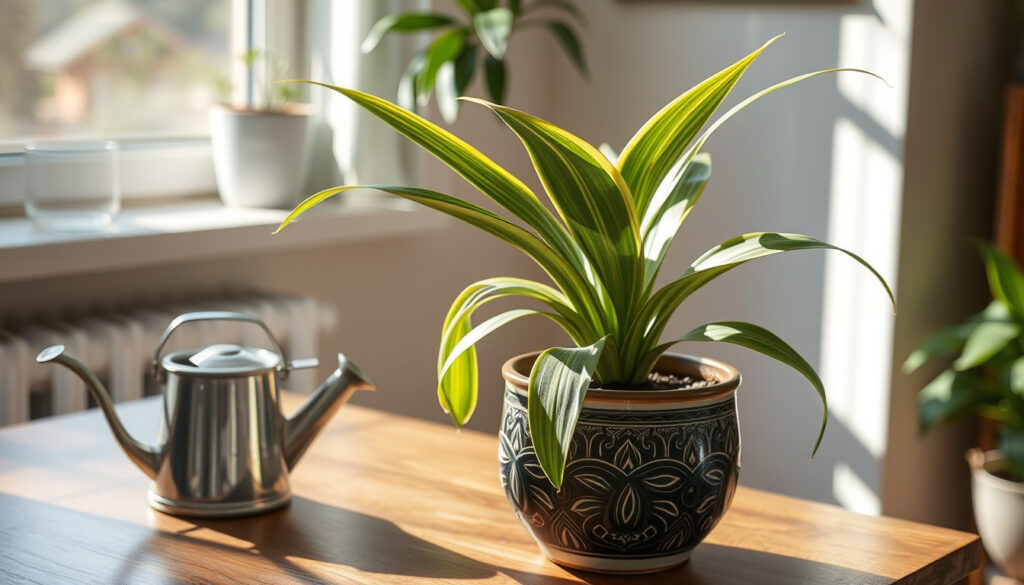
Happy Plant Care: Guide to Growing Dracaena fragrans
There’s something quietly reassuring about the Happy Plant (Dracaena fragrans)—it doesn’t demand much, yet rewards you with broad, glossy leaves and a calm presence that fits any room. Beneath its unassuming looks, this tropical houseplant is surprisingly good at filtering indoor air and adapting to low light, making it a top pick for modern homes.
Scientific name: Dracaena fragrans · Common names: Happy Plant, Corn Plant, Mass Cane · Native to: Tropical Africa · Indoor height: Up to 6 ft (1.8 m) · Light preference: Bright indirect light · Toxicity: Toxic to dogs and cats
Quick snapshot
- Happy Plant is Dracaena fragrans (Royal Horticultural Society (UK gardening authority)).
- Prefers bright indirect light; direct sun scorches leaves (NC State Extension (university horticulture)).
- Toxic to dogs and cats if ingested (Clemson HGIC (university extension)).
- Can tolerate low light but variegation may fade (Royal Horticultural Society).
- Exact flowering frequency indoors varies widely by environment.
- The optimal humidity level to prevent brown leaf tips is debated among growers.
- The role of fluoride in tap water causing tip burn is not fully proven.
- Ideal soil pH range for potted Dracaena fragrans is not consistently specified.
- Indoor flowering is rare and may take 5–10 years under optimal light and maturity (White Flower Farm (specialist nursery)).
- New shoots often emerge from the base after the main stem flowers and dies back. (White Flower Farm (specialist nursery))
- Propagation cuttings root in 2–4 weeks in water or moist soil. (White Flower Farm (specialist nursery))
- Follow the step-by-step care guide below for watering, light, and soil.
- Learn to propagate your Happy Plant from stem cuttings.
- Troubleshoot common problems like yellow leaves and brown tips.
8 key facts, one pattern: the Happy Plant thrives on consistency—steady light, moderate water, and a draft-free spot. Here’s a quick reference table.
| Attribute | Value |
|---|---|
| Scientific name | Dracaena fragrans |
| Common names | Happy Plant, Corn Plant, Mass Cane |
| Family | Asparagaceae |
| Native to | Tropical Africa |
| Indoor height | Up to 6 ft (1.8 m) |
| Light | Bright indirect light |
| Water | Moderate; let soil dry between waterings |
| Toxicity | Toxic to dogs and cats |
How do you take care of a happy plant?
What type of soil does a happy plant need?
- Use a peat-free, loam-based potting compost (Royal Horticultural Society (RHS, UK gardening body)).
- Add perlite or coarse sand to improve drainage and prevent waterlogging.
- Maintain slightly acidic pH (6.0–6.5) for optimal nutrient uptake.
The RHS, the UK’s leading horticultural authority, stresses that well-drained soil is non-negotiable. Waterlogged roots rot quickly, and a loose mix allows oxygen to reach the root zone.
How much light does a happy plant require?
- Bright, indirect light from an east- or west-facing window is ideal (RHS Growing Guide).
- Direct sun burns foliage (NC State Extension).
- Too little light causes leaves to narrow and lose variegation (NC State).
The implication: placing your plant a few feet from a bright window gives it the energy it needs without the risk of scorch. If the room is north-facing, consider supplementing with a grow light.
How often should I water my happy plant?
- Water when the top inch of soil feels dry (Plantura Magazin (gardening advice site)).
- Reduce watering in fall and winter; allow top 2 inches to dry (White Flower Farm).
- Use room-temperature water to avoid root shock.
The catch: overwatering is the most common killer. If leaves turn yellow and the soil stays wet, root rot is likely. Let the top inch dry out completely before watering again.
How to fertilize a happy plant?
- Feed monthly during spring and summer with a balanced liquid fertilizer diluted to half strength (RHS).
- Skip fertilizing entirely during winter dormant period.
- Excess fertilizer can cause salt buildup and brown leaf tips.
Why this matters: a light feeding schedule mimics the plant’s natural growth cycle. Too much nitrogen flushes soft growth that attracts pests.
How to propagate a happy plant?
- Take a 6-inch stem cutting with at least one node (Spider Farmer (indoor growing expert)).
- Remove lower leaves and place the cutting in a jar of water, submerging only the nodes.
- Change the water weekly; roots appear in 2–4 weeks.
- Once roots are 2 inches long, transplant into moist potting soil.
- Keep the new plant in bright indirect light and water sparingly until established.
Bottom line: Propagation is straightforward in spring. Use clean tools and avoid letting cuttings dry out. For beginners, water rooting gives visible progress.
Frequent small waterings keep soil moist but can lead to root rot if drainage is poor. Wait until the top inch is dry, then water thoroughly—that’s the happy medium for Happy Plants.
The pattern: consistent care prevents most issues. Nail the basics—well-draining soil, indirect light, measured watering—and the plant rewards you with steady growth.
Where is the best place to put a happy plant?
Can happy plants survive in low light?
- Yes, they tolerate low light but growth slows and leaves may lose variegation (RHS).
- In deep shade, the stem elongates and looks leggy.
The pattern: low light is survivable but not ideal. If your room is dim, rotate the plant occasionally to keep growth even.
Should I put my happy plant near a window?
- An east- or west-facing window behind a sheer curtain works best (RHS).
- A south-facing window is only suitable with sheer curtains to filter midday sun.
What is the ideal temperature for a happy plant?
- Daytime 60–70°F (15–21°C), night about 10°F cooler (Clemson HGIC).
- Keep away from drafts, heating vents, and air conditioners (Clemson HGIC).
- Minimum temperature 50°F (10°C) to avoid cold damage.
What this means: Happy Plants are tropical, not frost-tolerant. A stable indoor temperature prevents stress that leads to leaf drop.
Are happy plants indoor or outdoor?
Can happy plants be grown outdoors?
- Happy Plants are primarily indoor houseplants in most climates (NC State Extension).
- They can spend summer outdoors in shade, but must come inside before temperatures drop below 50°F.
What USDA zones are suitable for outdoor happy plants?
- Outdoor cultivation is possible in USDA zones 10–11, where frost doesn’t occur (NC State).
- In these zones, plant in shade or filtered light; direct sun burns leaves.
The implication: unless you live in a frost-free region, treat your Happy Plant as a permanent indoor companion. A summer vacation on a shaded patio is fine if you watch the thermostat.
How often does a happy plant flower?
What do happy plant flowers look like?
- Small, white, fragrant flowers borne on a tall spike (RHS).
- The bloom has a sweet, jasmine-like scent that fills a room.
How to encourage flowering in happy plants?
- Indoor flowering is rare; may occur every few years under ideal conditions (White Flower Farm).
- Requires bright light, mature plant (several years old), and possibly a brief temperature drop at night.
- After flowering, the stalk may die back; new shoots emerge from the base.
Bottom line: Don’t wait for flowers—they’re a bonus, not a measure of health. The plant’s lush foliage is its real show.
Many growers buy a Happy Plant expecting indoor flowers, but it’s the air-purifying leaves and easygoing nature that make it worth keeping. Focus on leaf health and you’ll be rewarded.
The catch: flowering is rare indoors. If it happens, enjoy it—but don’t chase blooms at the expense of leaf health.
What are common happy plant problems?
Why are my happy plant leaves turning yellow?
- Overwatering or underwatering—check soil moisture (ScottsMiracle-Gro (lawn & garden brand)).
- Yellow lower leaves can also indicate natural aging.
How to treat brown leaf tips?
- Brown tips often stem from low humidity, fluoride in tap water, or overfertilization (ScottsMiracle-Gro).
- Use filtered or distilled water and increase humidity with a pebble tray.
- Flush the soil every few months to leach excess salts.
What pests attack happy plants?
- Spider mites, mealybugs, and scale are common (Clemson HGIC).
- Treat with insecticidal soap or neem oil; isolate the plant to prevent spread.
- Check leaf axils weekly for early signs of infestation.
The pattern: most problems trace back to water stress or low humidity. A consistent routine eliminates 90% of complaints.
Confirmed facts
- Happy Plant is Dracaena fragrans (RHS).
- Prefers bright indirect light (NC State).
- Toxic to pets (Clemson HGIC).
- Tolerates low light but loses variegation (RHS).
What’s unclear
- Exact flowering frequency indoors varies greatly.
- Optimal humidity level for preventing brown tips is debated.
- Effect of fluoride in tap water on leaf tip burn is not fully proven.
- Ideal soil pH for potted plants is not standardized.
“Happy plants are among the easiest indoor plants to maintain, making them perfect for beginners.”
— Deep Green Permaculture (organic gardening resource)
“In warm, humid conditions and frost-free areas, happy plants can be grown outdoors successfully.”
— Yates Gardening (established Australian garden brand)
For indoor gardeners in the US and UK, the Happy Plant is a forgiving entry into houseplants, but its tolerance has limits. The clear takeaway: overwatering and poor light cause most failures. Dial in the basics—well-draining soil, bright indirect light, water only when the top inch is dry—and you’ll have a plant that outlasts many trendy alternatives. For the British gardener dealing with dimmer rooms, the RHS’s guidance on using an east-facing window is especially practical. The choice is straightforward: give it the conditions it evolved for in tropical Africa, or watch it struggle. Your Happy Plant will tell you which path you chose.
If you have a the Happy Plant, also known as Dracaena fragrans, you’ll find it responds well to similar care routines for light and watering.
Frequently asked questions
How often should I fertilize my happy plant?
Feed monthly during spring and summer with a balanced liquid fertilizer diluted to half strength. Do not fertilize in winter (RHS).
Why are my happy plant leaves turning brown?
Brown leaf tips are usually caused by low humidity, fluoride in tap water, or overfertilization. Use filtered water and increase humidity (ScottsMiracle-Gro).
How to prune a happy plant?
Prune in spring by cutting the cane at your desired height. New growth will appear just below the cut. Use clean, sharp shears.
Can I grow happy plant from cuttings?
Yes. Take a 6-inch stem cutting with a node, place in water or moist soil, and roots should appear in 2–4 weeks (Spider Farmer).
Is happy plant safe for pets?
No. All parts of Dracaena fragrans are toxic to dogs and cats if ingested (Clemson HGIC).
How to treat spider mites on a happy plant?
Wipe leaves with a damp cloth and apply insecticidal soap. Isolate the plant and increase humidity to discourage mites (Clemson HGIC).
More related posts
 Shaquille O’Neal: Net Worth, Children, Divorce, Sleep Apnea
 Denim Shorts in Ireland: Your 2026 Buying Guide for Women
 Mental Age Test – History, Formula and Accuracy
 Jack Harlow: Biography, Relationships, and Career
 Arabella Stanton: Biography, Ethnicity & Hermione Casting
 Andre Braugher Cause of Death: Lung Cancer, Tributes, and Legacy
 Wings of Fire: Age Rating, Bans & Kid-Friendly?
 Urinary Tract Infection Treatments – Proven Remedies and Prevention
