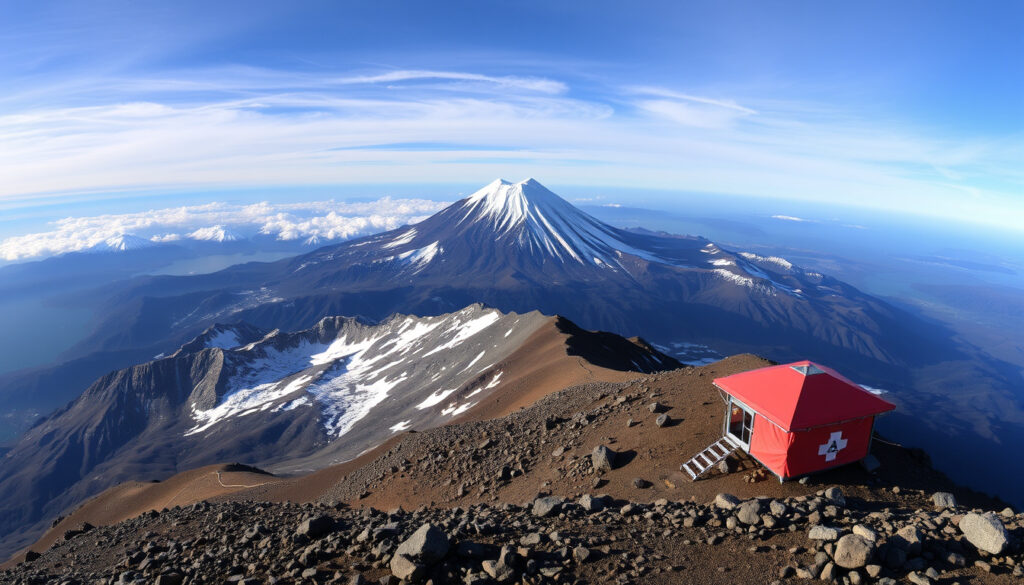
Mount Fuji Climbing Guide: Facts, Routes, and Safety Tips
There’s something about Mount Fuji that stops people mid-sentence. Whether it’s the near-perfect symmetrical cone rising above the clouds or the quiet knowledge that it remains an active volcano, Japan’s tallest peak draws over 300,000 climbers each year.
Height: 3,776 meters (12,388 feet) ·
Last Eruption: 1707–1708 (Hoei eruption) ·
Climbing Season: July to September ·
Location: Honshu, Japan ·
UNESCO World Heritage: Designated in 2013
Quick snapshot
- Mount Fuji is an active stratovolcano (Japan National Tourism Organization)
- Last eruption was 1707–1708 (Japan Guide)
- Height is 3,776 meters (Japan National Tourism Organization)
- Exact date of next eruption is unknown
- Long-term effectiveness of the view barrier is uncertain
- Future changes to climbing regulations due to overtourism
- 663 AD — First recorded ascent (Japan National Tourism Organization)
- 1707–1708 — Last major eruption (Japan Guide)
- 2013 — UNESCO World Heritage designation (UNESCO World Heritage Centre)
- Potential eruption monitoring by Japan Meteorological Agency
- Tourism management changes after 2024 barrier controversy
- Possible climbing regulation updates for 2026 season
Six key facts, one pattern: Mount Fuji’s story is a blend of precise data and centuries of human interaction.
| Fact | Value |
|---|---|
| Elevation | 3,776 m (12,388 ft) |
| First Recorded Ascent | 663 AD by an anonymous monk |
| Last Eruption | 1707–1708 (Hoei eruption) |
| Climbing Season | July 1 – September 10 |
| Number of Climbers per Year | Approximately 300,000 |
| Official Website | Mount Fuji official climbing website |
The implication: Mount Fuji is both a precisely measured natural landmark and a living cultural site with a history that stretches back more than 1,300 years.
How long does it take to climb Mount Fuji?
The average climb time on the most popular route — the Yoshida Trail — is 5 to 7 hours up and 3 to 5 hours down, according to Japan Guide. Most climbers start from the Fuji Subaru Line 5th Station at 2,300 meters elevation, cutting out the lower portion of the mountain. The full round trip typically runs 8 to 12 hours depending on your pace, weather, and crowd conditions.
What is the best time to climb?
- Official season: July 1 to September 10 on the Yamanashi side (Yoshida Trail) and July 10 to September 10 on the Shizuoka side (NAVITIME Travel).
- Peak weeks: Late July to late August see the heaviest traffic and most reliable weather.
- Off-season climbing: Technically possible but dangerous — mountain huts are closed, trails are unmaintained, and temperatures drop well below freezing.
The Yoshida Trail opened on July 1, 2025, while the Shizuoka Prefecture trails opened on July 10, 2025 (nippon.com).
What are the climbing routes?
Mount Fuji has four official routes, each with a distinct character, as outlined by the Japan National Tourism Organization.
- Yoshida Trail: Most popular and accessible. Starts at 2,300 m on the Yamanashi side. Has many mountain huts and a separate descent trail. Daily limit of 4,000 hikers in 2025, with 3,000 advance slots and 1,000 same-day slots (Japan Guide).
- Fujinomiya Trail: Shortest and steepest route. Starts at 2,400 m on the Shizuoka side. Popular for sunrise summit attempts.
- Subashiri Trail: Quieter option that merges with the Yoshida Trail near the summit. Starts at 2,000 m.
- Gotemba Trail: Longest and least developed. Starts at 1,400 m. Steep gravel descent makes it a challenge for knees.
The Yoshida Trail offers the most infrastructure and support, but its 4,000-person daily cap means advance booking is essential. The quieter Shizuoka routes demand more fitness but reward with fewer crowds.
Is Mount Fuji still active?
Yes — Mount Fuji is an active stratovolcano, monitored continuously by the Japan Meteorological Agency. It is not a dead volcano, nor is it dormant in the geological sense. It has erupted 17 times in recorded history, with the most recent event being the Hoei eruption of 1707–1708.
When was Mount Fuji’s last eruption?
The Hoei eruption began on December 16, 1707, and lasted until January 1, 1708. It produced ashfalls that reached present-day Tokyo, about 100 kilometers away. According to Japan Guide, no eruption has occurred since, but the volcano remains seismically active with small earthquakes recorded regularly.
What is the current volcanic alert level?
- Alert Level 1 (as of 2025) — normal activity, no imminent eruption risk.
- Monitoring: The Japan Meteorological Agency uses seismometers, GPS stations, and tiltmeters to detect ground deformation.
- Expert assessment: Scientists estimate a 1–2% probability of a small-to-moderate eruption within the next 30 years, based on historical recurrence intervals.
Over 300,000 people climb Fuji annually, and millions live in the Greater Tokyo area. An eruption of even moderate size would disrupt air travel, agriculture, and daily life across central Japan.
The implication: Mount Fuji is a quiet but not silent volcano. The infrastructure that supports mass tourism exists on top of a geological system that demands respect.
Can beginners climb Mount Fuji?
Yes — with proper preparation. According to Japan National Tourism Organization, beginners can attempt the climb, and many guided tours cater specifically to first-timers. The Yoshida Trail is the recommended route for novices due to its frequent rest stops, mountain huts, and well-marked paths.
What fitness level is required?
- You should be comfortable walking uphill for 5–7 hours with a daypack.
- Altitude sickness becomes a real risk above 2,500 meters — about 10–20% of climbers experience symptoms (Japan Guide).
- Training recommendation: 4–6 weeks of stair climbing, hiking, or incline treadmill work before your trip.
What gear is needed?
- Sturdy hiking boots with ankle support
- Layered clothing (temperatures at the summit drop to 5–10°C even in August)
- Rain jacket and pants (weather changes rapidly)
- Headlamp (summit sunrise hikes start in darkness)
- Water (2–3 liters minimum) and high-energy snacks
- Cash for mountain hut fees (huts charge 7,000–10,000 yen per night)
The catch: altitude sickness affects people regardless of fitness. Even experienced hikers can be stopped by the thin air above 3,000 meters. The key is pacing — slow and steady wins the summit.
Why is Mount Fuji so famous?
Mount Fuji’s fame rests on three pillars: its iconic shape, its deep cultural roots, and its UNESCO status. It is a national symbol of Japan, appearing on everything from currency to postage stamps, and has been celebrated in art and literature for centuries.
What cultural significance does Mount Fuji have?
- Art: Katsushika Hokusai’s “36 Views of Mount Fuji” (1830s) made the mountain a global visual icon.
- Religion: Fuji has been a sacred site for Shinto and Buddhist pilgrims since at least the 7th century. The first recorded ascent was by an anonymous monk in 663 AD (Japan National Tourism Organization).
- National identity: The mountain is often used as a shorthand for Japan itself in international media.
What are 5 facts about Mount Fuji?
- It is Japan’s tallest peak at 3,776 meters (12,388 feet).
- It is an active stratovolcano with 17 recorded eruptions.
- It was designated a UNESCO World Heritage Site in 2013 as a “sacred place and source of artistic inspiration” (UNESCO World Heritage Centre).
- It has four distinct climbing routes, each with a different starting elevation and difficulty level.
- It is visible from Tokyo on clear days, approximately 100 km away.
The pattern: Mount Fuji is not just a mountain — it is a cultural artifact, a religious symbol, and a natural landmark all in one. Its fame is earned through centuries of human meaning-making, not just its height.
Why is Japan blocking Mount Fuji?
In 2024, the town of Fujikawaguchiko erected a large barrier to block a popular photo spot of Mount Fuji. The decision was driven by overtourism — specifically, the behavior of visitors who trespassed onto private property, blocked traffic, and left trash while trying to capture the perfect shot.
What is the Fujikawaguchiko town barrier?
The barrier is a 2.5-meter-high, 20-meter-long mesh screen installed along a sidewalk near a Lawson convenience store. The spot had become famous on social media as a place where Fuji appears to rise dramatically behind the store. According to BBC News, the town’s mayor stated that the decision was made after repeated complaints from residents about tourists blocking the sidewalk and entering private property.
Why was the view blocked?
- Safety hazards: Tourists stood in the middle of the street to take photos.
- Privacy violations: Visitors entered adjacent private lots and gardens.
- Litter: The area accumulated trash daily despite cleaning efforts.
- Traffic disruption: The narrow road became congested with parked rental cars and tour buses.
The barrier is a symptom of a broader overtourism problem. Japan welcomed over 36 million foreign visitors in 2024, and Mount Fuji’s iconic status makes it a flashpoint. Other towns may follow Fujikawaguchiko’s lead if crowd behavior doesn’t improve.
The implication: the same social media exposure that made Mount Fuji a global phenomenon is now forcing local governments to manage the consequences. The barrier is a symbol of the tension between access and preservation.
Steps to prepare for your Mount Fuji climb
Preparation separates a successful summit from a miserable failure. Here are the essential steps, based on guidance from Japan National Tourism Organization and Japan Guide.
- Book your mountain hut in advance — huts fill up weeks ahead during peak season, especially on the Yoshida Trail.
- Pay the 4,000 yen climbing fee — mandatory since 2025 for all four trails (Japan Guide). The voluntary 1,000 yen contribution was abolished in 2025.
- Reserve your Yoshida Trail slot — 3,000 advance slots are available online; 1,000 same-day slots remain but are not guaranteed.
- Pack layers and rain gear — summit temperatures hover around 5°C in August, and sudden storms are common.
- Train with stair climbing — 4–6 weeks of stair workouts build the specific endurance needed for the 1,400-meter vertical ascent from the 5th Station.
- Plan your start time — most climbers begin at 8–10 PM for a sunrise summit, or 6–8 AM for a daytime climb. Trailheads close to day hikers from 2 PM to 3 AM for those without hut reservations (Japan Travel).
Timeline
- 663 AD — First recorded ascent by an anonymous monk (Japan National Tourism Organization).
- 1707–1708 — Last major eruption (Hoei eruption), covered Tokyo in ash (Japan Guide).
- 2013 — Designated a UNESCO World Heritage Site as a “sacred place and source of artistic inspiration” (UNESCO World Heritage Centre).
- 2024 — Fujikawaguchiko town erects barrier to block view of Mount Fuji due to overtourism (BBC News).
Clarity: what we know and what we don’t
Confirmed facts
- Mount Fuji is an active volcano (Japan National Tourism Organization).
- Last eruption was in 1707–1708 (Japan Guide).
- Height is 3,776 meters (12,388 feet) (Japan National Tourism Organization).
- Climbing season is July 1 – September 10 (NAVITIME Travel).
- Mandatory 4,000 yen climbing fee was introduced in 2025 (Japan Guide).
What’s unclear
- Exact date of next eruption is unknown — scientists estimate a 1–2% probability within 30 years.
- Long-term effectiveness of the Fujikawaguchiko barrier remains uncertain.
- Future changes to climbing regulations due to overtourism pressures are still being debated.
Quotes
Mount Fuji is a sacred place and a source of artistic inspiration, embodying the cultural heritage of Japan.
— Japan National Tourism Organization (official tourism authority)
The barrier was a necessary measure to protect the safety and privacy of local residents. We had to act after repeated complaints about tourists blocking the sidewalk and entering private property.
— Mayor of Fujikawaguchiko town, via BBC News
Altitude sickness is the most common reason climbers turn back. It doesn’t matter how fit you are — if you ascend too quickly, your body will force you to stop.
— Japan Guide (climbing advisory)
For climbers planning a trip, the choice is clear: prepare thoroughly, book early, and respect the mountain’s dual nature as both a tourist destination and an active geological system. Those who skip the preparation risk altitude sickness, denied access, or a 12-hour ordeal they won’t forget. Those who plan well get a sunrise from 3,776 meters — and a story that lasts a lifetime.
Related reading: One Piece Characters · Water Bottles Ireland
travelandtourworld.com, japangotravel.com, upi.com, fujinomiya.gr.jp, jen.jiji.com, en.wikivoyage.org, gov-online.go.jp
For those planning their ascent, a detailed climbing guide offers comprehensive route information and safety advice.
Frequently asked questions
What should I bring to climb Mount Fuji?
Bring sturdy hiking boots, layered clothing, a rain jacket, headlamp, 2–3 liters of water, high-energy snacks, cash for mountain huts, and your 4,000 yen climbing fee receipt. Trekking poles are recommended for the descent.
Is there a mountain hut on Mount Fuji?
Yes — mountain huts are located at each station along the Yoshida and Fujinomiya trails. They cost 7,000–10,000 yen per night and must be booked in advance during peak season.
How much does it cost to climb Mount Fuji?
In 2025, the mandatory climbing fee is 4,000 yen per person. Mountain hut accommodation costs 7,000–10,000 yen per night. Guided tours range from 15,000–30,000 yen depending on the provider and services included.
Do I need a guide to climb Mount Fuji?
No — the Yoshida Trail is well-marked and can be climbed independently. However, guided tours are recommended for beginners, non-Japanese speakers, or anyone concerned about altitude sickness.
Can I climb Mount Fuji in one day?
Yes — a day climb is possible, especially on the shorter Fujinomiya Trail (5–7 hours round trip). However, most climbers prefer an overnight stay at a mountain hut to catch the sunrise from the summit.
What is the altitude sickness risk on Mount Fuji?
Altitude sickness affects about 10–20% of climbers above 2,500 meters. Symptoms include headache, nausea, dizziness, and shortness of breath. The only treatment is descent. Ascend slowly and hydrate frequently.
Are there restrooms on the climbing trails?
Yes — restrooms are available at each mountain station and at the 5th Station trailheads. They are basic (pit toilets) and cost 100–200 yen per use. Carry small change and your own toilet paper.
More related posts
 Toy Poodle: Lifespan, Care, and Ownership Tips
 Galaxy Z Fold 7: Ireland Prices, Specs & Buy Guide
 Lionel Richie: Family, Marriages, Career & News 2025
 Alexis Bledel: Biography, Ethnicity, Children, and Career
 Jetstar Return for Free – 2025 Policy and Change Guide
 Joe Keery: Relationships, Music, and Career in 2025
 IKEA As Is – Discounts, Policies and Shopping Guide
 Hill’s Science Diet: Vet Reviews, Pros, Cons & Recalls
