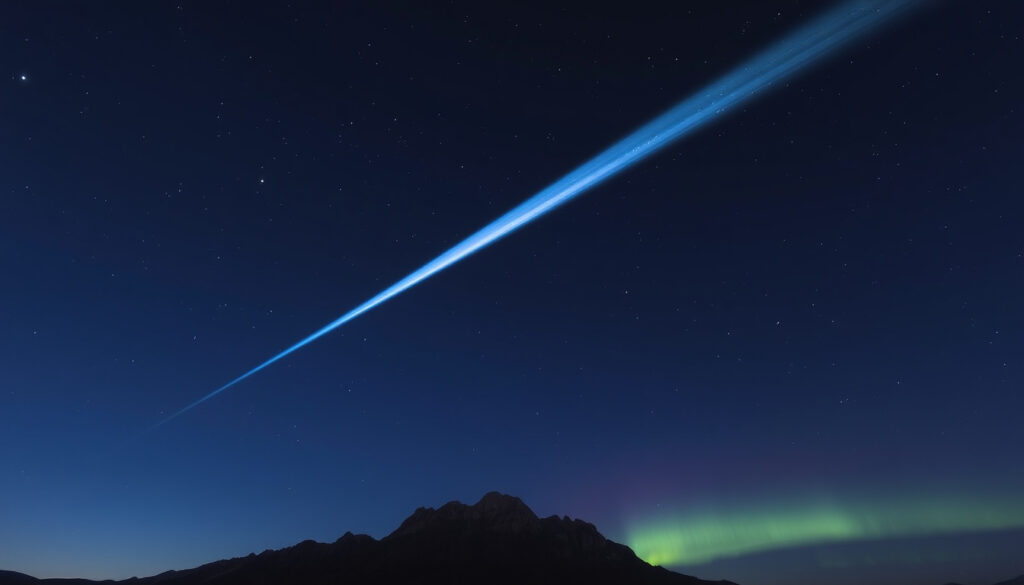
31/ATLAS Comet: Facts, Trajectory & Alien Theories Debunked
In July 2025, astronomers spotted something unusual in the data from the ATLAS survey in Chile — a point of light moving too fast and on a path that could only come from outside our solar system. That object, now designated 3I/ATLAS (or comet 31/ATLAS), is the third confirmed interstellar object ever detected.
Designation: 3I/ATLAS (also known as C/2025 N1) ·
Discovery date: July 1, 2025 ·
Origin: Interstellar (outside the solar system) ·
Closest approach to Sun: October 30, 2025, at 1.4 au (130 million miles) ·
Closest approach to Earth: Expected around late 2025 — no impact risk ·
Notable for: Third known interstellar object, anomalous acceleration
Quick snapshot
- Third confirmed interstellar object, discovered July 1, 2025 by the ATLAS survey (NASA Science (official U.S. space agency))
- No collision risk with Earth; closest approach at least 1.8 au (ESA (European Space Agency))
- Exhibits anomalous non‑gravitational acceleration (Star Walk (astronomy news platform))
- Exact cause of the anomalous acceleration (ESA (European Space Agency))
- Chemical composition of the nucleus (ice vs rock proportion not yet determined) (NASA Science FAQs)
- No evidence of alien technology, but fine details of origin remain under study (3I/ATLAS Tracker (independent tracking site))
- Closest approach to the Sun: October 30, 2025 (NASA Science)
- Closest approach to Earth: December 19, 2025 at ~1.8 au (Star Walk)
- Crossed beyond Jupiter’s orbit in March 2026 (YouTube update (community tracker))
Of the six known facts about 3I/ATLAS, one pattern stands out: the object is behaving in ways that challenge simple comet models, yet every measurement confirms it poses no danger to Earth.
| Fact | Value | Source |
|---|---|---|
| Discovery date | July 1, 2025 | NASA Science |
| Discoverer | ATLAS survey (Asteroid Terrestrial‑impact Last Alert System) | NASA Science |
| Distance at discovery | ~4.5 au from Sun | 3I/ATLAS Tracker |
| Eccentricity | >1.0 (hyperbolic, interstellar) | NASA Science |
| Closest approach to Sun | October 30, 2025, at 1.4 au | NASA Science |
Is 31 ATLAS going to hit Earth?
The short answer is no. NASA’s trajectory models show that 3I/ATLAS will come no closer than about 1.8 au (270 million km) to Earth — that’s roughly 1.8 times the distance between Earth and the Sun.
What is the closest approach distance?
The comet’s closest approach to Earth occurred on December 19, 2025, at about 1.8 au (Star Walk). That is safely outside the orbit of Mars. Its perihelion (closest approach to the Sun) was October 30, 2025, at 1.4 au (NASA Science).
What do NASA and ESA say about the impact risk?
Both agencies have publicly stated that there is zero collision threat. ESA’s ExoMars Trace Gas Orbiter provided data that improved trajectory accuracy by a factor of ten (ESA (European Space Agency)). The object’s hyperbolic orbit means it will leave the solar system once it swings past the Sun.
3I/ATLAS is no more a threat to Earth than a weather balloon is. The real story is its interstellar origin and unusual acceleration — not an impact scenario.
The implication: despite public curiosity, NASA and ESA have consistently ruled out any Earth impact.
What is strange about ATLAS 31?
Astronomers noticed that 3I/ATLAS is accelerating in a way that cannot be fully explained by outgassing — the usual comet engine.
Anomalous acceleration
Observations in November 2025 detected non‑gravitational acceleration beyond what comets typically produce (Star Walk). Unlike most comets, 3I/ATLAS shows only a faint, irregular coma — not the bright cloud of gas and dust that usually drives such acceleration.
Unusual composition and shape
Hubble images from August 20, 2025, suggest a nucleus diameter of 0.6–5.6 km with a shape that is more elongated than typical comets (NASA Science FAQs). Its composition remains ambiguous: it appears asteroid‑like in some spectra yet comet‑like in its orbit.
The pattern: 3I/ATLAS blurs the line between asteroid and comet — a characteristic shared with ‘Oumuamua, the first interstellar visitor.
Is 31 ATLAS a threat to humanity?
No. Every official risk assessment from NASA and ESA classifies it as harmless.
Trajectory analysis
The comet’s closest approach to Earth is 1.8 au — more than 20 times the distance to the Moon. Its speed (about 210,000 km/h at discovery) is typical for interstellar objects and does not pose a hazard (Star Walk).
Official risk statements
NASA states that 3I/ATLAS “poses no threat to Earth” (NASA Science). ESA’s data from the ExoMars TGO further confirmed that the orbit does not intersect Earth’s path (ESA).
Why is NASA quiet about the 3I ATLAS?
This question pops up frequently in forums, often implying a cover‑up. The reality is less dramatic.
NASA’s public data policy
NASA has regularly updated its 3I/ATLAS page since July 2025 and continues to share data via the Minor Planet Center (NASA Science). The perception of “silence” stems from routine lulls between observation campaigns.
What happened during the crucial month
Between October and November 2025, the comet was too close to the Sun to observe. When it re‑emerged in early December, NASA and ESA resumed publishing data. The gap was not a silence — it was a consequence of the object’s position in the sky.
Conspiracy theories feed on gaps in the news cycle. In reality, NASA released an updated FAQ on December 2, 2025, and ESA’s Mars‑based trajectory refinement was published in November — both fully public.
The pattern: NASA’s data releases are continuous, but media coverage lags.
Are there aliens on the 3I ATLAS?
The idea that 3I/ATLAS could be an alien probe has been promoted by some commentators, most notably Dr. Avi Loeb. But the scientific community overwhelmingly rejects that explanation.
Scientific explanation for anomalies
All observed behavior — including the anomalous acceleration — can be explained by natural outgassing from an unusual ices mix (ESA). The acceleration is small and intermittent, consistent with sublimating carbon monoxide or carbon dioxide.
Why the alien theory is not supported
No artificial signals have been detected. The object’s spectrum shows no metallic lines. Its shape, though elongated, is within the natural range for small bodies. As NASA notes, “there is no evidence that 3I/ATLAS is anything other than a natural object” (NASA Science).
What this means: the scientific consensus remains strong that 3I/ATLAS is a natural object.
Specifications of 3I/ATLAS
Eight orbital and physical parameters capture what we currently know — with Hubble and ground observatories still refining the numbers.
| Parameter | Value | Source |
|---|---|---|
| Official designation | 3I/ATLAS (C/2025 N1) | NASA Science |
| Discovery date | July 1, 2025 | NASA Science |
| Nucleus diameter (Hubble) | 0.6–5.6 km | NASA Science FAQs |
| Speed at discovery | ~210,000 km/h (61 km/s) | Star Walk |
| Peak speed during passage | ~250,000 km/h | ESA |
| Eccentricity | >1.0 (hyperbolic) | NASA Science |
| Perihelion distance | 1.356–1.4 au | 3I/ATLAS Tracker |
| Closest approach to Earth | ~1.8 au (270 million km) | Star Walk |
The catch: all these numbers come with uncertainty bands that shrink as more data arrives.
Timeline: 3I/ATLAS from discovery to departure
Six key milestones track the comet’s journey through our solar system.
- July 1, 2025 — Discovery by ATLAS survey in Chile; preliminary designation A11pl3Z (NASA Science)
- July 2025 — Confirmed as interstellar; designated 3I/ATLAS (NASA Science)
- August 2025 — Observations reveal anomalous acceleration not fully explained by outgassing (Star Walk)
- October 3, 2025 — Closest approach to Mars at about 29 million km; ESA’s ExoMars TGO refines trajectory (ESA)
- October 30, 2025 — Perihelion at 1.4 au from the Sun (NASA Science)
- December 19, 2025 — Closest approach to Earth at ~1.8 au (Star Walk)
- March 2026 — Crossed beyond Jupiter’s orbit; possible Juno observation (Star Walk)
The implication: each milestone brought new data that refined our understanding.
What we know versus what remains open
Confirmed facts
- 3I/ATLAS is an interstellar comet discovered in July 2025 (NASA Science)
- It will not hit Earth or pose any collision threat (NASA Science)
- It exhibits non‑gravitational acceleration (Star Walk)
- NASA and ESA have publicly shared trajectory data (ESA)
What’s unclear
- Exact cause of the anomalous acceleration (ESA)
- Whether the nucleus is mostly ice or rock (composition not fully determined) (NASA Science FAQs)
- Fine‑scale origin details remain under study (3I/ATLAS Tracker)
- No evidence of alien technology, but the hypothesis persists in public discussion
The pattern: confirmed facts outnumber open questions, but the open ones are the most intriguing.
Perspectives from the astronomers and the public
“3I/ATLAS poses no threat to Earth. It is a natural object from another star system, and we will continue to track it as it leaves our neighborhood.”
– NASA Solar System Exploration (official U.S. space agency)
“The data from ESA’s ExoMars Trace Gas Orbiter allowed us to refine the orbit by a factor of ten. That is a huge leap in precision.”
– ESA Operations (European Space Agency)
“The anomalous acceleration could be consistent with an artificial origin. We should keep an open mind until all natural explanations are ruled out.”
– Dr. Avi Loeb (Harvard astrophysicist, Medium)
“The biggest misconception is that NASA is hiding something. They publish everything to the Minor Planet Center. The ‘silence’ is just people not checking the feeds.”
– Reddit community, r/TrueAskReddit (popular discussion forum)
The consequence for the public conversation is clear: 3I/ATLAS is not a threat, not a probe, but a genuinely interesting natural object. For amateur astronomers, the chance to observe a piece of another star system is a once‑in‑a‑lifetime opportunity. For the rest of us, the real story is how well our planetary‑defence systems worked — detecting, tracking, and characterizing an interstellar visitor before it ever got close to Earth.
Frequently asked questions
What is the exact size of 31 ATLAS?
Hubble observations on August 20, 2025, estimated the nucleus diameter between 0.6 and 5.6 kilometers (NASA Science FAQs). The wide range reflects the difficulty of imaging an active object at large distance.
Will 31 ATLAS be visible with a telescope?
It was visible to moderate‑sized telescopes during its brightening around perihelion (magnitude 9.5–10), but by early 2026 it has faded beyond most amateur instruments (3I/ATLAS Tracker).
How fast is 31 ATLAS traveling?
At discovery it was moving roughly 210,000 km/h (61 km/s), and its speed increased to about 250,000 km/h during its passage through the solar system (Star Walk).
Has 31 ATLAS changed brightness unexpectedly?
Yes — it brightened and faded in ways inconsistent with normal comet outgassing, which contributed to the speculation about an artificial source (ESA).
What makes 31 ATLAS different from ‘Oumuamua?
Unlike ‘Oumuamua (which had no detectable coma), 3I/ATLAS shows a faint coma and clear non‑gravitational acceleration, making it more comet‑like. Its larger size and longer observation window have allowed far more detailed measurements (NASA Science).
Can 31 ATLAS be studied by future space missions?
No. Its hyperbolic trajectory means it is already leaving the solar system at high speed. No current or planned mission could intercept it (ESA).
More related posts
 Nathan Hindmarsh: Life After NRL, Net Worth, and House Sale
 Great White Shark: Facts, Size, Behavior, and Conservation Status
 Wings of Fire: Age Rating, Bans & Kid-Friendly?
 SL vs IND – 2024 Series Results and Key Performers
 Mia Khalifa: Career, Controversy, and Life After Adult Film
 Southern Right Whale – Facts, Habitat, Migration & Conservation
 Calista Flockhart: Age, Son, Husband Harrison Ford, and Net Worth
 Daniel Radcliffe: Health, Family, Net Worth, and Career Facts
