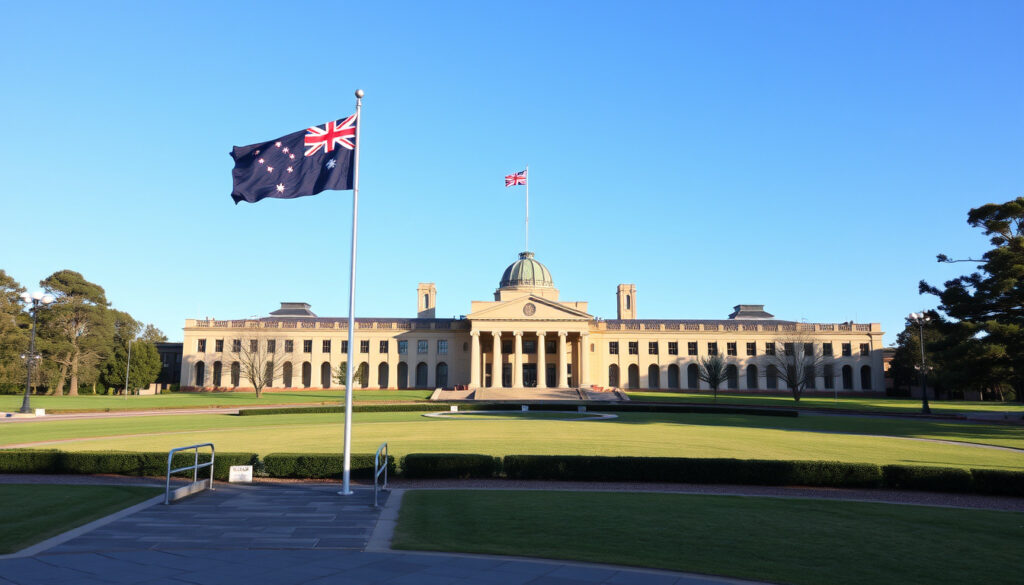
Robert Menzies: Australia’s Longest-Serving Prime Minister
Few Australian politicians have shaped the nation as deeply as Robert Menzies. He led the country through the opening years of World War II and returned after the war to preside over nearly seventeen years of peacetime expansion, his political career spanning two prime ministerial terms and the founding of the Liberal Party.
Years served as prime minister: 18 years (two non-consecutive terms: 1939–1941, 1949–1966) ·
Birth and death: 20 December 1894 – 15 May 1978 ·
Political party: Liberal Party of Australia (founder) ·
Total terms: 2 (7th and 12th overall in terms of length) ·
Preceded by: Earle Page (first term), Ben Chifley (second term) ·
Succeeded by: Arthur Fadden (first term), Harold Holt (second term)
Quick snapshot
- Menzies served two non-consecutive terms as prime minister (National Museum of Australia)
- Resigned in 1941 due to loss of parliamentary confidence (National Archives of Australia)
- Founded the Liberal Party in 1944 (John Curtin Prime Ministerial Library)
- No significant uncertainties in the historical record; most key facts are well-documented by government archives and academic sources.
- 26 April 1939: becomes PM; 3 Sept 1939: declares war; 29 Aug 1941: resigns; 1944: founds Liberal Party; 19 Dec 1949: returns as PM; 26 Jan 1966: retires (National Archives of Australia)
- Historical reassessments continue; recent scholarship examines Menzies’ role in Australia’s alliance with the United States and his social policies (Britannica)
Eight key facts about Menzies’ life and career, pulled from official records and institutional biographies, reveal a clear picture of his trajectory from barrister to Australia’s longest-serving prime minister.
| Full name | Sir Robert Gordon Menzies |
|---|---|
| Born | 20 December 1894, Jeparit, Victoria, Australia |
| Died | 15 May 1978, Melbourne, Victoria, Australia |
| Political party | United Australia Party (until 1944), Liberal Party of Australia (1944–1978) |
| Terms as prime minister | First: 26 April 1939 – 29 August 1941; Second: 19 December 1949 – 26 January 1966 |
| Total time in office | 18 years, 168 days |
| Predecessor | Earle Page (first term), Ben Chifley (second term) |
| Successor | Arthur Fadden (first term), Harold Holt (second term) |
Why did Robert Menzies stop being Prime Minister?
Loss of parliamentary support in 1941
- Menzies resigned as prime minister on 29 August 1941 after members of his own United Australia Party withdrew their confidence (National Archives of Australia)
- The party was fracturing, and Menzies’ leadership during the early war years had drawn criticism from within his cabinet and from the Labor opposition (John Curtin Prime Ministerial Library)
Menzies lost his party’s trust while leading Australia into war, yet he would return to power eight years later and win seven consecutive elections. The 1941 collapse wasn’t a judgment on his abilities — it was a party revolt born of wartime stress.
Voluntary retirement in 1966
- By January 1966, Menzies had led the Liberal Party to seven consecutive federal election victories. He retired on his own terms, stepping down on 26 January 1966 and handing power to his deputy Harold Holt (National Archives of Australia)
- He was 71 years old and had served 16 years in his second term. His retirement was widely seen as the end of an era — the close of the “Menzies era” that had defined postwar Australian politics (National Museum of Australia)
The implication: Menzies’ first term ended in political defeat, but his second ended in a carefully planned exit that allowed the Liberal Party to maintain power under new leadership. Two very different ends to two very different premierships.
What did Robert Menzies do in WWII?
Prime Minister at the outbreak of war
- Menzies became PM on 26 April 1939, just months before Germany invaded Poland. On 3 September 1939, he announced that Australia was at war — following Britain’s declaration against Germany (John Curtin Prime Ministerial Library)
- As wartime leader, he oversaw the initial mobilization of Australian forces, the creation of the Second Australian Imperial Force, and the commitment of troops to the Middle East and North Africa (Britannica)
Wartime leadership and resignation
- Menzies struggled to maintain a stable war cabinet. Labor leader John Curtin declined to join a national government, and internal discontent within the United Australia Party grew. Menzies resigned in August 1941, replaced by Arthur Fadden (National Archives of Australia)
- His departure came just months before the Pacific war erupted — Japan attacked Pearl Harbor in December 1941, shifting Australia’s strategic focus from Europe to the Pacific.
After his first term
- After leaving office, Menzies served on the Advisory War Council under Curtin, contributing to war planning until 1944 (John Curtin Prime Ministerial Library)
- During this period he began building the coalition that would become the Liberal Party, giving a series of speeches — most famously “The Forgotten People” in May 1942 — that laid out a vision for a middle-class, anti-socialist Australia (Robert Menzies Institute)
Menzies’ wartime experience cut both ways: it ended his first prime ministership, but it also gave him the political architecture and public platform he would later use to build the Liberal Party and win back power in 1949.
This dual outcome shows how a crisis that ended one term could seed the next.
What did Robert Menzies say about Queen Elizabeth?
“I did but see her passing by”
- During Queen Elizabeth II’s visit to Australia in 1963, Menzies quoted a line from a 19th-century poem by William Johnson Cory: “I did but see her passing by, and yet I love her till I die” (National Museum of Australia)
- The remark was made during a speech at a state banquet and became one of the most famous quotes associated with any Australian prime minister. It reflected Menzies’ well-known devotion to the monarchy and his personal admiration for the Queen.
Context of the 1963 visit
- The Queen’s 1963 tour marked the first time a reigning monarch had visited Australia since her 1954 coronation tour. Menzies, then in his 14th consecutive year as PM, was widely regarded as a staunch monarchist — described as “British to his bootstraps” (National Archives of Australia)
- The line was not spontaneous poetry; Menzies had used it before. But in the context of the royal tour, it captured the sentimental loyalty that defined his brand of conservatism.
Why this matters: The quote has been replayed in Australian media ever since, cementing Menzies’ image as the ultimate monarchist. It also highlights the cultural gulf between his era and Australia’s later shift toward republicanism.
How long did Robert Menzies serve as prime minister?
First term (1939–1941)
- Menzies’ first term lasted 2 years, 4 months and 3 days — from 26 April 1939 to 29 August 1941 (National Archives of Australia)
- He was 44 years old when sworn in, making him one of Australia’s younger prime ministers at the time (National Archives of Australia)
Second term (1949–1966)
- His second term was dramatically longer: 16 years, 1 month and 7 days, from 19 December 1949 to 26 January 1966 (National Archives of Australia)
- This period covered seven consecutive federal election wins for the Liberal-Country Party Coalition, an unprecedented run in Australian politics.
Total tenure record
- Combined, Menzies served 18 years and 168 days — by far the longest of any Australian prime minister. The next closest, John Howard (1996–2007), served 11 years and 263 days (National Archives of Australia)
- His record still stands. No prime minister since has come within six years of matching it.
The trade-off: Menzies’ longevity came at the cost of policy boldness — critics argue his era was one of managerial stability rather than transformation. Supporters counter that the stability itself was his greatest achievement.
What is Robert Menzies’ legacy in Australian politics?
Founder of the Liberal Party
- Menzies founded the Liberal Party of Australia in 1944, merging several smaller anti-Labor groups into a single conservative force (National Museum of Australia)
- The party has governed Australia for more than half of the years since its founding, making Menzies the architect of Australia’s most durable political institution.
Postwar economic expansion
- Menzies presided over a period of sustained economic growth, full employment, mass immigration from Europe, and rapid suburban expansion. His government boosted manufacturing, invested in higher education, and expanded social services (Britannica)
- He strengthened Australia’s defense alliance with the United States through the ANZUS treaty (1951) and committed troops to the Korean War and the Vietnam War (National Archives of Australia)
- Immigration from Europe, particularly from Southern Europe, reshaped the country’s demographics. The “Menzies era” became synonymous with the postwar boom and the rise of a suburban, car-owning middle class.
Social policies and the “Menzies era”
- Socially conservative, Menzies maintained the White Australia policy and opposed Asian immigration. He championed family values, home ownership, and the role of the nuclear family as the bedrock of society.
- His government’s “Home Savings Grant” scheme and support for home ownership embedded the idea of the “Australian dream” — a house on a quarter-acre block — that persisted for decades (Robert Menzies Institute)
Modern historians debate whether Menzies’ legacy is one of visionary leadership or fortunate stewardship. The economy grew on the back of global demand for Australian wool and minerals; his government’s policy initiatives were often cautious. For younger Australians re-evaluating the postwar consensus, the question is whether the “Menzies era” was a product of its time or a blueprint worth preserving.
This blend of achievement and controversy defines the Menzies imprint on Australia.
Timeline
Eleven key dates trace Menzies’ journey from a country town in Victoria to the prime minister’s office and his enduring influence on Australia.
- 20 December 1894 — Born in Jeparit, Victoria (Australian Dictionary of Biography)
- 1928 — Elected to Victorian Legislative Council (National Archives of Australia)
- 1934 — Elected to federal parliament; appointed Attorney-General (National Archives of Australia)
- 26 April 1939 — Becomes Prime Minister after death of Joseph Lyons (John Curtin Prime Ministerial Library)
- 3 September 1939 — Australia declares war on Germany (John Curtin Prime Ministerial Library)
- 29 August 1941 — Resigns as Prime Minister after losing party support (National Archives of Australia)
- 1944 — Founds the Liberal Party of Australia (National Museum of Australia)
- 19 December 1949 — Returns as Prime Minister after defeating Ben Chifley (National Archives of Australia)
- 1963 — Quotes “I did but see her passing by” during Queen Elizabeth’s visit (National Museum of Australia)
- 26 January 1966 — Retires from politics; succeeded by Harold Holt (National Archives of Australia)
- 15 May 1978 — Dies in Melbourne at age 83 (National Archives of Australia)
Confirmed facts
- Menzies served two non-consecutive terms as prime minister (National Museum of Australia)
- He resigned in 1941 due to loss of parliamentary confidence (National Archives of Australia)
- He founded the Liberal Party in 1944 (John Curtin Prime Ministerial Library)
- He is Australia’s longest-serving prime minister (National Archives of Australia)
- He died on 15 May 1978 (National Museum of Australia)
Quotes
“I did but see her passing by, and yet I love her till I die.”
— Robert Menzies, during Queen Elizabeth II’s 1963 visit to Australia (National Museum of Australia)
In his 1942 “The Forgotten People” speech, Menzies defined his target audience: those who do not call themselves working class but who work, look after their homes, save, and strive to be independent (Robert Menzies Institute).
Menzies’ words from 1963 and 1942 define the two poles of his public image: the sentimental monarchist and the champion of the middle class. Together, they explain how a wartime leader who lost his party’s confidence could later become the most successful peacetime prime minister in Australian history. For Australians examining the foundations of their political system, the choice is clear: to understand the Liberal Party, postwar prosperity, and Australia’s alliance with the West, you start with the man from Jeparit.
morethanourchildhoods.org, en.wikipedia.org, menziesrc.org, ebsco.com, jstor.org, youtube.com
Frequently asked questions
What was Robert Menzies’ first profession?
Menzies was a barrister. He was admitted to the Bar on 13 May 1918 and practiced law before entering politics (Australian Dictionary of Biography).
Did Robert Menzies serve in the military?
No. Menzies did not serve in the military. He was of military age during World War I but did not enlist, a fact that sometimes drew criticism later. However, he was deeply involved in defense policy as prime minister during World War II.
Was Robert Menzies a monarchist?
Yes, Menzies was a staunch monarchist. He often expressed loyalty to the British Crown and famously quoted a poem about Queen Elizabeth II during her 1963 visit. The National Archives of Australia notes he was “British to his bootstraps.”
How did Robert Menzies die?
Robert Menzies died on 15 May 1978 in Melbourne at the age of 83. The cause of death was not widely publicized, but he had been in declining health for some years (National Archives of Australia).
What is the Robert Menzies College?
The Robert Menzies College is a residential college at Macquarie University in Sydney, named in his honor. It was established to promote leadership and academic excellence in line with his values.
Did Robert Menzies support the White Australia policy?
Yes, Menzies’ government maintained the White Australia policy, which restricted non-European immigration. He was socially conservative and the policy was not seriously challenged during his tenure (Robert Menzies Institute).
What was the relationship between Robert Menzies and Harold Holt?
Harold Holt was Menzies’ deputy and successor. Holt served as Treasurer and Minister for Immigration under Menzies and was loyal throughout the long second term. Menzies publicly endorsed Holt as his successor, and Holt took over in January 1966.
Related reading
- Peter Lalor — Another figure who shaped Australian political history from outside the establishment, later entering parliament.
- Queen Victoria — The British monarch whose reign shaped the imperial context in which Menzies grew up and which he defended throughout his career.
More related posts
 Thailand and Cambodia War: 2025 Border Crisis Explained
 GWM Haval Raptor Hi4 PHEV – Specs, Price, Australia Launch
 Latest News Melbourne: Crime Surge, Teen E-Bike Death
 Rachel Weisz: Biography, Age, Marriage, Baby at 48
 Calista Flockhart: Age, Son, Husband Harrison Ford, and Net Worth
 Wednesday Season 3 – Release Date and Production Updates
 Homer Simpson: Voice Actor, IQ, Health, and Family Facts
 Find My School: How to Look Up Your Roll Number in Ireland
